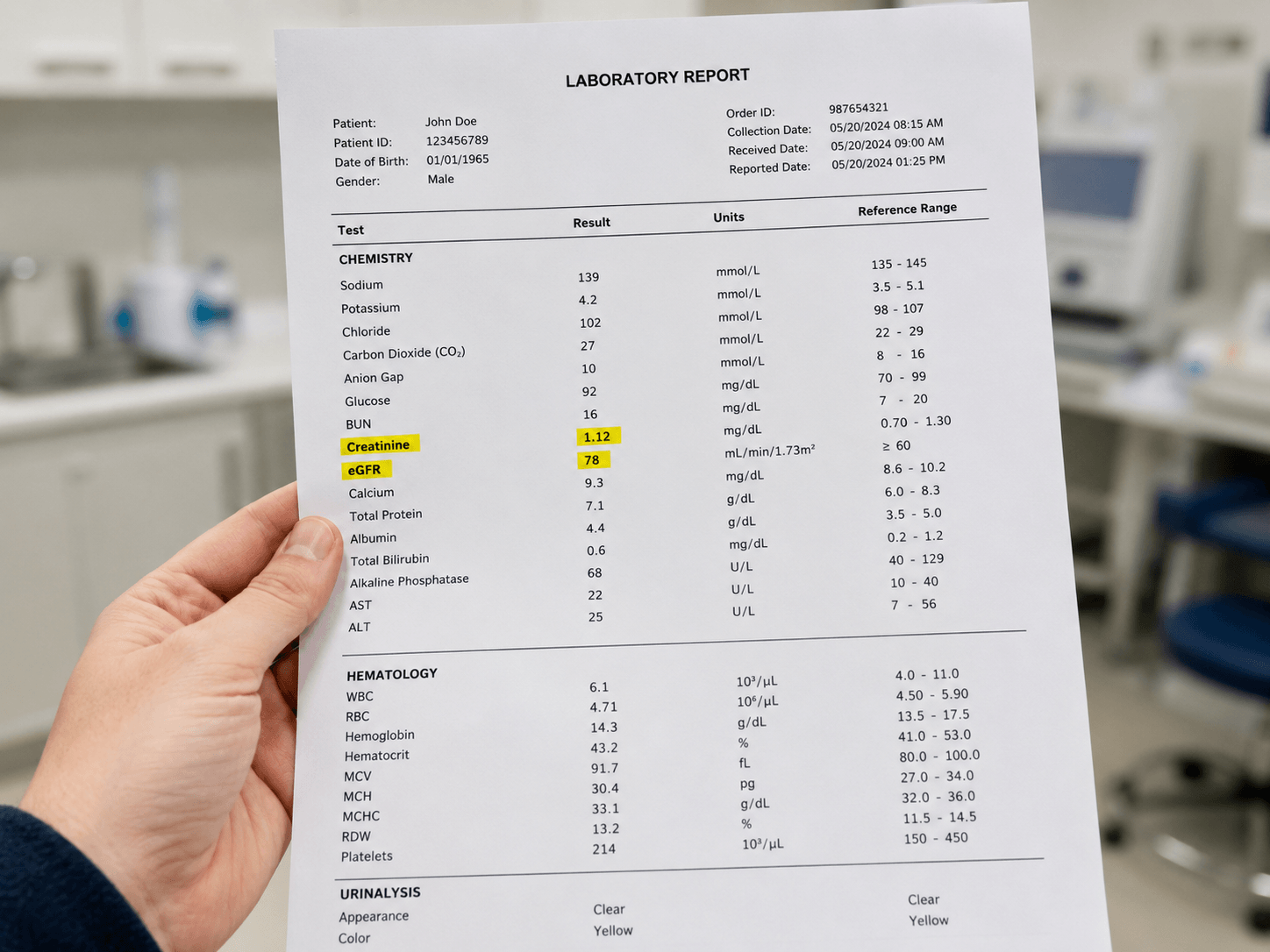
Creatinine, eGFR, and Urinalysis: How to Read Your Kidney Lab Results
You opened the envelope from the lab and saw three or four numbers next to your name. Creatinine. eGFR. Urinalysis. Maybe a UACR if your doctor was being thorough. The reference ranges are printed right there, but no one explained which number actually matters or what to do if one is off.
This guide walks through each test in plain English, with Philippine reference ranges, so you can read your own results before your follow-up visit.
Why these three tests are usually ordered together
The kidneys do two main jobs: filter waste from blood and prevent useful things (like protein) from leaking into urine. A single test can tell you about one of those jobs but not both.
Creatinine measures waste in the blood
eGFR estimates filtering capacity
Urinalysis (with UACR) checks for leaks
Reading them together gives a much fuller picture than any single test alone. That's why doctors order them as a panel for kidney screening.
Test 1: Serum creatinine
Creatinine is a waste product your muscles produce constantly. Healthy kidneys filter it out and pass it into urine. When kidney filtering drops, creatinine builds up in the blood.
Normal range in the Philippines (most labs):
Adult men: 0.7 to 1.3 mg/dL
Adult women: 0.6 to 1.1 mg/dL
Women run lower because they have less muscle mass on average.
What can throw the number off temporarily:
Heavy meat meal the day before
Strenuous workout in the last 24 hours
Dehydration (concentrates creatinine)
Creatine supplements (gym supplements)
Pregnancy (lowers creatinine, naturally)
A single high reading doesn't equal kidney disease. Doctors usually repeat the test in 4-6 weeks before drawing conclusions. Trend matters more than any one value.
Test 2: eGFR (estimated Glomerular Filtration Rate)
eGFR estimates how many milliliters of blood your kidneys filter per minute. It's calculated automatically from your creatinine, age, and sex.
Why eGFR matters more than creatinine alone. A 75-year-old woman and a 30-year-old man can have the same creatinine of 1.0 mg/dL. The man's eGFR might be 95 (normal). The woman's eGFR might be 55 (stage 3 CKD). The raw creatinine looks identical; the kidney function is very different.
eGFR ranges and what they mean:
eGFR | What it suggests |
|---|---|
90 or above | Normal filtering |
60-89 (with kidney damage signs) | Mildly reduced |
45-59 | Stage 3a CKD (mild to moderate) |
30-44 | Stage 3b CKD (moderate to severe) |
15-29 | Stage 4 CKD (severe) |
Below 15 | Stage 5 CKD (kidney failure) |
The 3-month rule. A single low eGFR is not enough to diagnose CKD. Per international guidelines, CKD requires eGFR below 60 sustained for 3 months or longer (or other markers of kidney damage).
Test 3: Urinalysis (and UACR)
A standard urinalysis screens for many things at once: blood, sugar, protein, signs of infection. For kidney health specifically, the most important add-on is UACR (Urine Albumin-to-Creatinine Ratio).
UACR measures how much albumin (a protein) leaks into your urine. Healthy kidneys do not leak protein.
UACR ranges:
Under 30 mg/g: normal
30 to 300 mg/g: microalbuminuria (early kidney damage)
Above 300 mg/g: macroalbuminuria (significant damage)
UACR is especially important for diabetics and people with high blood pressure. It catches damage that creatinine and eGFR miss in the earliest stages.
Standard urinalysis findings to know:
Blood in urine: can mean infection, kidney stones, or kidney damage. Always worth follow-up.
Protein on dipstick: correlates roughly with UACR but less precise. UACR is the better test.
Glucose in urine: suggests poorly controlled blood sugar (or a much rarer kidney glucose problem).
Leukocytes and nitrites: suggest urinary tract infection.
Specific gravity: measures urine concentration. Very dilute or very concentrated urine on its own usually doesn't mean kidney problems.
Reading them together
Creatinine normal + eGFR above 60 + UACR under 30: kidneys look healthy. Repeat in one year if you have diabetes or hypertension.
Creatinine normal + eGFR above 60 + UACR 30-300: early kidney damage despite normal filtering. This is the sweet spot for catching damage early.
Creatinine slightly high + eGFR 45-59: stage 3a CKD. Time to see a nephrologist.
Any combination with eGFR below 30: prompt nephrologist visit, often within weeks.
Sudden change in creatinine (e.g., 1.0 last year, 1.8 today): even within "normal" range, a fast change deserves explanation.
Red flags that mean see a doctor soon
Sudden swelling in legs, ankles, or around the eyes
Visible blood in urine
Foamy urine that doesn't go away
Sharp drop in urine output
New, hard-to-control high blood pressure
Unexplained fatigue plus low urine output
These can mean acute kidney injury, which is sometimes reversible if treated quickly.
Frequently asked questions
My creatinine is normal but my eGFR is 55. Is that a contradiction?
Not at all. Creatinine looks normal because the reference range is wide. eGFR adjusts for your age and sex and reveals what the raw creatinine hides. Trust the eGFR.
Can drinking lots of water lower my creatinine?
Hydration normalizes creatinine. Severe dehydration falsely raises it. But chugging water won't "flush" damaged kidneys. Hydrate normally; don't megadose.
My urinalysis says "trace protein." Should I worry?
Maybe not. Trace protein on a dipstick is common and often not significant. UACR is the precise follow-up. Ask your doctor to order it if you have any kidney risk factors.
Are home creatinine kits accurate?
For screening, they're better than nothing, but lab tests are the standard for diagnosis and monitoring. Use home kits as an early signal, then confirm with a lab.
My eGFR went from 70 to 55 in one year. Is that bad?
A drop of more than 5 mL/min in a year is faster than expected age-related decline. Talk to a nephrologist. Causes can include uncontrolled blood pressure, uncontrolled diabetes, NSAID use, infection, or progression of underlying kidney disease.
Should I get tested even if I feel fine?
Yes, if you're over 40, have hypertension, have diabetes, have a family history of kidney disease, or take NSAIDs regularly. Kidney damage is silent until it's severe. Yearly testing catches it early.
Next step
If any of your numbers are concerning, the next step is usually a nephrologist consultation. They can interpret the full picture, recommend additional tests if needed, and build a plan to slow or stop kidney damage.